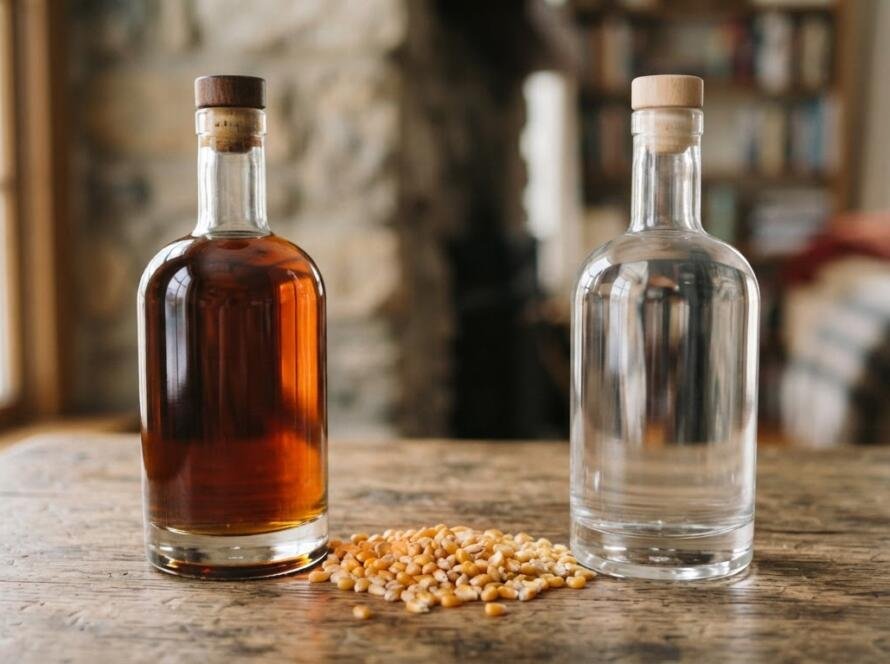

The angel’s share is the whiskey that evaporates through the wood of a barrel while it ages. Producers commonly cite about 2 percent a year in cool, damp Scotland and about 4 percent a year in Kentucky, with hot climates losing far more. The spirit leaves as water and alcohol vapor, straight through the oak and into the warehouse air. That is angels share whiskey in a nutshell, and the rest of this article is the part I would tell you at the tasting bar once you asked a follow-up question.
Where the angel’s share actually goes
A barrel is not a sealed can. Oak is a porous wood, and even a tight, well-made barrel breathes. Alcohol and water molecules work their way through the staves and the heads and drift off into the air around the barrel.
Nothing mystical happens to it. It does not get stored somewhere. It is simply gone, which is why distillers have always liked the poetic name. Calling it “inventory shrinkage” never caught on.
One more wrinkle: not every missing drop evaporated. According to one distillery’s explainer, the first year tends to be the heaviest loss, partly because fresh, dry oak soaks up some spirit that never evaporates at all. That soaked-in spirit stays in the wood. Some folks call it the devil’s cut.
How much angels share whiskey loses by climate
Temperature is the biggest lever. Heat pushes vapor through the wood faster. The figures vary by source and by warehouse, but the commonly cited ranges look like this:
- Scotland: roughly 2 percent of the barrel per year, helped by cool, humid air.
- Kentucky: roughly 4 percent per year, with some sources putting it anywhere from 3 to 6 percent.
- Tropical and very hot regions: much higher. One source cites 8 to 12 percent a year for a distillery in Taiwan, and others put India in a similar range.
Those numbers compound, because each year’s loss comes out of a smaller volume. Run the math on seven years of aging:
- At 2 percent a year, a barrel ends up with about 87 percent of what went in.
- At 4 percent a year, about 75 percent.
- At 10 percent a year, a bit under half.
So a long-aged American whiskey can finish with a fraction of its starting fill. That is a big reason older bottles cost what they do. The angels are expensive guests.
For the Scotland and Kentucky comparison, the sources I checked include this breakdown of how bourbon and Scotch change with age. Treat all of these as industry averages, not guarantees. Every warehouse writes its own number.
Humidity decides whether the proof goes up or down
Here is the part that surprises people. The angels take water and alcohol, but not in equal amounts. It depends on the air.
In a hot, dry warehouse, relatively more water escapes than alcohol, so the strength of the spirit in the barrel can rise over time. In a cool, very humid warehouse, less water escapes relative to alcohol, so the strength can drift down. This is why Kentucky bourbon can come out of the barrel stronger than it went in, while Scotch often comes out weaker.
Which way a given barrel goes depends on its own conditions, so you cannot predict it from the state name alone. If the strength numbers on a label feel slippery, our guide to proof versus ABV on a whiskey label walks through how to read them.
Warehouse effects: floors, walls and barrel size
Climate is the big picture. The warehouse is the fine print.
Height matters
Heat rises. In a multi-story warehouse, the top floors run hotter than the bottom floors, sometimes by a wide margin in summer. The Glenlivet notes that a Kentucky summer can push the top of a warehouse far above the bottom floor’s temperature. Barrels up high lose liquid faster and mature faster. Barrels down low go slower and gentler. Two barrels filled on the same day can taste like cousins, not twins.
Barrel size matters
Smaller barrels expose more wood surface for the amount of spirit inside. That means more contact with the oak and a higher percentage lost to evaporation. A small barrel can move quickly, but it also pays more to the angels.
Seasons matter
Places with real seasons, including New York, swing between hot summers and cold winters. Warm weather pushes spirit into the wood. Cold weather draws it back out. That cycling is part of how color and flavor build up in the barrel. If you have wondered where bourbon gets its color, we covered the wood side in why bourbon is brown.
Is the angel’s share a loss or a feature?
Both. Evaporation costs the distiller volume, and nobody enjoys watching a barrel shrink. But the same breathing that lets spirit escape also lets air in, and that exchange is part of how whiskey matures. Producers describe it as a trade: you give up some liquid, and you get concentration and development in return.
It has a limit, though. Leave a barrel too long, especially in a hot spot, and the wood can take over. The skill is knowing when to pull a barrel, not simply waiting as long as possible. Age is a number on a label. Balance is what you taste.
What this means for the bottle in your hand
When you pour an older whiskey, you are tasting spirit that stuck around through many seasons of the angels taking their cut. That is the quiet logic behind a bottle like New York Terebelo 7 Year Bourbon. Each year in the barrel is another year of evaporation, and the distiller has to decide it was worth it.
If you are curious about the topic, try this at home: pour two whiskeys of different ages side by side and compare them slowly, with a splash of water. You are not looking for a winner. You are looking at what time did.
FAQ
What is the angel’s share in whiskey?
It is the portion of whiskey that evaporates through the wood of the barrel during aging. It is a mix of water and alcohol vapor, and it never makes it into the bottle.
How much whiskey is lost to the angel’s share each year?
It depends on climate and warehouse. Producers commonly cite roughly 2 percent a year in Scotland and about 4 percent in Kentucky, while very hot regions can lose 8 to 12 percent or more. The loss compounds over the years.
Does the angel’s share change the proof?
It can. In hot, dry conditions the strength of the spirit in the barrel tends to rise, and in cool, humid conditions it tends to fall. Distillers often adjust the final strength with water before bottling.
Why do barrels on higher warehouse floors lose more?
Heat rises, so the upper floors are warmer. Warmer barrels lose liquid faster and mature faster than barrels on cooler lower floors.
Is it a waste?
It is a cost, but it is also part of how whiskey matures. The air exchange that lets vapor escape is part of the aging process, so distillers accept the loss as the price of the result.
Want to taste what patience in oak can do? Browse the full lineup in the Terebelo shop, and find a bottle worth waiting on.
Terebelo spirits are for adults 21 and over. Please enjoy responsibly and never drink and drive.